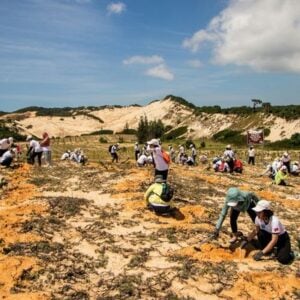
The United Nations World Food Programme (WFP) has welcomed the recognition of its Sahel Integrated Resilience Initiative as a United Nations World Restoration Flagship, highlighting large-scale efforts to restore degraded land and improve food security across Burkina Faso, Chad, Mali, Mauritania and Niger.
Since 2018, the WFP-led programme has worked with governments, local communities and development partners to improve livelihoods and food production for more than four million people. The initiative has also rehabilitated more than 335,000 hectares of degraded land along the edge of the Sahara Desert while helping communities become better prepared for climate and other shocks.
The recognition was announced during the 17th session of the Conference of the Parties to the United Nations Convention to Combat Desertification in Ulaanbaatar, Mongolia. The initiative is among three new World Restoration Flagships recognized under the UN Decade on Ecosystem Restoration for demonstrating large-scale and long-term approaches to ecosystem recovery.
The programme combines land restoration with school meals, nutrition support, assistance for smallholder farmers and capacity building for local institutions. This integrated approach aims to strengthen both environmental conditions and the livelihoods of communities facing persistent food insecurity.
In Niger, WFP reached more than 1.4 million people through resilience activities in 2025, making it the organization’s largest programme of its kind in the region. Evidence suggests these investments can be up to 3.5 times more cost-effective than humanitarian response and could potentially help avoid as much as US$9.7 billion in future humanitarian assistance needs by 2055.
Across Burkina Faso, Chad, Mali and Mauritania, more than 2.4 million people benefited from integrated resilience interventions in 2025. Satellite monitoring showed improved soil and vegetation conditions at 75 percent of WFP resilience sites.
Food security among participating households also improved. The share of households requiring humanitarian food assistance between harvests declined from 44 percent in 2020/2021 to 33 percent in 2024/2025.
The recognition comes as conflict, displacement, climate shocks, economic pressures and environmental degradation continue to threaten food security across the Sahel. An estimated 7.4 million people were projected to experience Crisis-level food insecurity or worse during the June to August 2026 lean season.
The initiative aims to restore 475,000 hectares of degraded land by 2030 while supporting biodiversity, livelihoods and long-term food security. Continued investment will be essential to expand successful restoration efforts and help more communities reduce their dependence on humanitarian assistance.
Supported by Germany, Canada, the United Kingdom, Denmark, Switzerland and other partners, the Sahel Integrated Resilience Initiative demonstrates how land restoration and food security programmes can work together to strengthen communities and build resilience against future crises.