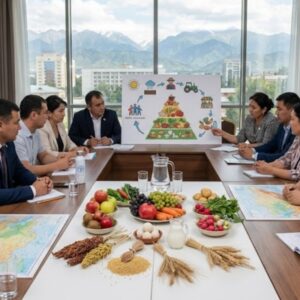
Budapest — June 1, 2026 — The Food and Agriculture Organization of the United Nations (FAO) has highlighted practical, scalable bioeconomy approaches in agriculture during a virtual event held on May 28. The session marked the launch of the publication Case studies promoting bioeconomy through agricultural practices in Europe and Central Asia, featuring examples of sustainable and circular farming practices already in use across the region.
Opening the event, Raimund Jehle, FAO Deputy Regional Representative, emphasized that bioeconomy approaches are vital to tackling challenges such as climate change, biodiversity loss, land degradation, and water scarcity. “Bioeconomy is not a single model – it can take many forms depending on local resources, ecosystems and traditions, but all share a common goal: using biological resources more sustainably,” he said.
Speakers presented diverse case studies, including regenerative organic farming in Austria, agroecological symbiosis in Finland, circular farming in Latvia, data‑driven legume production in Serbia, women‑led textile cooperatives in Türkiye, and conservation agriculture in Uzbekistan. Each example demonstrated how resource efficiency, local knowledge, and innovation can strengthen rural livelihoods while reducing environmental impact.
Organic farmer Alfred Grand from Austria underscored the role of organic farming in maintaining soil health and minimizing fossil fuel use, while Gülçin Gürsoy from Türkiye shared how her cooperative created jobs and income for women through traditional weaving with locally sourced organic cotton, linen, and hemp.
The publication builds on FAO’s broader regional work on sustainable bioeconomy, following discussions at the Thirty‑fifth Session of the FAO Regional Conference for Europe in Dushanbe last month. FAO officials stressed that moving from awareness to implementation requires policy support, investment, and partnerships.
Lev Neretin, FAO Environment Team Leader, concluded by noting that transformation depends on practical solutions rooted in country realities and traditions. The event reinforced FAO’s commitment to helping member states scale up bioeconomy approaches for sustainable agrifood systems.