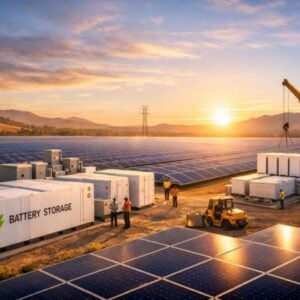
Detroit — May 30, 2026 — Ford Motor Company (NYSE: F) has officially entered the utility market with the launch of Ford Energy, a new subsidiary backed by a $2 billion investment. The move positions Ford as a hyperscaler in the energy sector, manufacturing lithium‑iron‑phosphate (LFP) battery energy storage systems (BESS) designed for utilities, industrial customers, and AI data centers facing unprecedented power demands.
Production will begin at a repurposed Kentucky battery plant, with first deliveries expected in late 2027. Ford Energy is targeting 20 GWh of annual deployments, and has already secured framework interest, including a reported multi‑year deal with EDF Power Solutions.
Meeting the AI Power Crunch The surge in AI and data center growth is driving U.S. electricity demand to new highs, with forecasts suggesting consumption could triple. Grid interconnection delays and capacity constraints have created opportunities for companies to deliver behind‑the‑meter solutions. Ford Energy’s large‑scale batteries will provide dispatchable backup power, complementing gas generation and renewables to support 24/7 AI workloads.
Investor Perspective Ford’s pivot leverages its EV battery expertise, repurposing assets from its scaled‑back electric vehicle unit. Analysts estimate Ford Energy could become a $10 billion business, modeled after Tesla’s fast‑growing energy storage segment. Despite winding down parts of its EV push, Ford’s core auto divisions remain strong, with Ford Blue and Ford Pro delivering solid earnings. Shares have surged nearly 30% since the announcement, hitting multi‑year highs.
Strategic Significance Ford Energy joins energy giants like Chevron, ExxonMobil, EQT, and Liberty Energy, all of whom are investing in dedicated power solutions for hyperscalers. By entering the battery storage space, Ford provides the missing piece of the puzzle — reliable, scalable energy for AI data centers.
The hyperscaler utility market is wide open, and Ford’s bold move signals a new era where legacy industrials repurpose expertise to meet the demands of the AI energy revolution