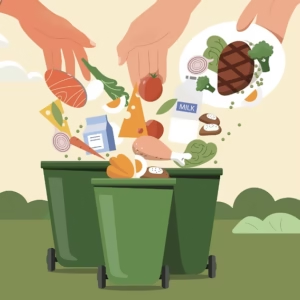
Food loss and waste often happen quietly across the food value chain, beginning long before food reaches consumers. In warehouses, fields, processing units, retail stores, and food service operations, edible food is lost due to bruising, delays, strict quality standards, forecasting errors, and storage limitations. These small inefficiencies accumulate at each stage, resulting in significant overall losses that are often overlooked.
To address this challenge, the Food and Agriculture Organization of the United Nations (FAO) has launched an open-access course titled “Tackling Food Loss and Waste across the Agrifood Systems” through its Virtual Learning Center. Developed by the FAO Regional Office for Europe and Central Asia in collaboration with the International Food Waste Coalition under WRAP Europe, the course examines how food loss occurs across production, processing, retail, and food service systems and explores practical ways to reduce it without requiring complete system redesign.
Across the value chain, the course highlights that food loss has different drivers at each stage. In primary production, it is often linked to harvesting decisions and market demand fluctuations. In processing, edible food is rejected due to strict specifications. In retail and hospitality, losses commonly arise from poor forecasting, storage challenges, and portion management.
FAO experts emphasize that reducing food loss begins with measurement but must move toward action. The course is designed to help practitioners identify root causes, apply solutions, and track improvements over time using practical tools and real-world case studies. It combines technical knowledge with field experience to support measurable reductions in food loss and waste.
The initiative also reflects a growing global shift toward treating food loss as a measurable and manageable issue. It draws on established frameworks such as the FAO and UNEP methodologies and the Food Loss and Waste Accounting and Reporting Standard, helping users apply structured approaches like Target-Measure-Act to improve outcomes across the supply chain.
The course includes six modules covering all major stages of the food system, along with measurement tools, case studies, and applied examples from different regions. It also features insights on consumer food waste, including contributions from the European Commission’s Directorate-General for Health and Food Safety. Designed for global accessibility, it can be taken sequentially or used as a reference resource.
A pilot version of the course in early 2025 brought together 171 participants from 11 countries across Europe, Central Asia, the Caucasus, and Türkiye, including farmers, processors, retailers, policymakers, and civil society actors. The shared experience highlighted that while contexts differ, the challenge of reducing food loss is universal.
Overall, the course does not offer a single solution but provides practical tools to understand, measure, and gradually reduce food loss across the agrifood system, turning knowledge into actionable improvements.