• Skip to primary navigation
  • Skip to main content
  • Skip to primary sidebar

fundsforNGOs News

Grants and Resources for Sustainability

  • Subscribe for Free
  • Premium Support
  • Premium Sign in
  • Premium Sign up
  • Home
  • Grants & Funding
    • Funds for NGOs
      • Agriculture, Food & Nutrition
      • Animals and Wildlife
      • Arts & Culture
      • Children
      • Civil Society
      • Community Development
      • Democracy and Good Governance
      • Economic Development
      • Education
      • Disability
      • Employment and Labor
      • Environment
      • Family Support
      • Healthcare
      • HIV and AIDS
      • Housing & Shelter
      • Humanitarian Relief
      • Human Rights
      • Human Service
      • Information Technology
      • Livelihood Development
      • LGBTQIA2S+
      • Media and Development
      • Narcotics, Drugs and Crime
      • Old Age Care
      • Peace & Conflict Resolution
      • Poverty Alleviation
      • Refugees, Migration & Asylum Seekers
      • Science & Technology
      • Sports & Development
      • Sustainable Development
      • Water, Sanitation & Hygiene (WASH)
      • Women & Gender
      • Youth & Adolescents
    • Donors & Funders
    • Funds for Companies
      • Accounts & Finance
      • Agriculture, Food and Nutrition
      • AI
      • Education
      • Energy
      • Environment
      • Healthcare
      • Innovation
      • Manufacturing
      • Media
      • Research
      • Startups & Early-Stage
      • Sustainable Development
      • Technology
      • Travel & Tourism
      • Women
      • Youth
    • Funds for Individuals
  • Funds in Your Country
  • Proposal Writing
    • Sample Proposals
    • Agriculture Proposals
    • Business Proposals
    • Child Development Proposals
    • Climate Change & Biodiversity Proposals
    • Community Development Proposals
    • Democracy & Good Governance Proposals
    • Disability Proposals
    • Disaster & Humanitarian Relief Proposals
    • Environment Proposals
    • Education Proposals
    • Healthcare Proposals
    • Housing & Shelter Proposals
    • Human Rights Proposals
    • Livelihood Development Proposals
    • Nutrition & Food Security Proposals
    • Poverty Alleviation Proposals
    • Refugees, Migration & Asylum-Seekers’ Proposals
    • Rural Development Proposals
    • Sustainable Development Proposals
    • Water, Sanitation & Hygiene (WASH) Proposals
    • Women & Gender Proposals
    • Youth Development Proposals
  • Premium
    • Premium Sign-in
    • Premium Grants
    • Premium eBooks
    • Premium Webinars
    • Premium Videos
    • Premium Courses
    • Premium Support
  • NGOs.AI
  • Contact
    • Submit Your Opportunity
    • Learning Lab
    • Q&A
    • News
    • About us
You are here: Home / cat / From Waste to Wealth: Transforming South Asia’s Food Systems for a Sustainable Future

From Waste to Wealth: Transforming South Asia’s Food Systems for a Sustainable Future

Dated: November 19, 2025

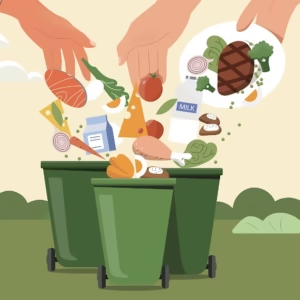
South Asia, home to nearly two billion people, loses up to 40% of its food before it reaches consumers—an enormous challenge but also a major opportunity for transformation. With rising climate pressures, persistent undernutrition, and a rapidly growing youth population, the region is now mobilizing policy, innovation, and investment to build more resilient and efficient food systems.

At a special SAPLING session during World Food India 2025, government representatives from Bhutan, India, Maldives, and Sri Lanka, along with private-sector and civil-society leaders, highlighted how food processing, circular economy approaches, and technological solutions are already reshaping agri-food systems. The central message was that transforming waste into wealth is no longer aspirational—it is actively happening across the region.

Bhutan faces severe post-harvest losses, with half of its fruits and vegetables wasted annually. In response, the country has updated its food and nutrition policy to include food loss assessments and subsidies covering up to 70% of storage, transport, and packaging costs for farmer groups. The Maldives, where food waste accounts for 60% of municipal waste, is integrating circular economy principles into urban planning and food security policy, exploring biotech and waste valorization to reduce environmental strain.

India, which processes only 12% of its agricultural output, is witnessing a rise in women-led agribusiness models and grassroots innovation. The Nilgiri Farmer Producer Organization in Rajasthan has shown how women’s collectives can create profitable processing enterprises, while companies like S4S Technologies are empowering thousands of women smallholders through solar-powered processing, financial access, and market linkages. These initiatives have reduced waste, increased incomes, and demonstrated how processing innovation can drive rural transformation.

Sri Lanka, where food loss reaches 40% each year, is shifting from a self-sufficiency approach toward a modern, market-driven agribusiness model. By investing in cold chains, value addition, digital platforms, and AI-enabled solutions, the country aims to create skilled jobs, reduce losses, and enhance global competitiveness. Government-backed programs, including World Bank-supported investments, are helping develop climate-resilient crops and smallholder agribusiness capacities.

Regional entrepreneurs are also redefining waste. Sri Lanka’s Senzagro provides precision agriculture tools to tens of thousands of farmers, yielding high returns through productivity and loss reduction. India’s GreenPod Labs extends produce shelf life using plant-based technologies, while Vietnam Food converts shrimp byproducts into valuable products with high efficiency and reduced resource use.

New financing models are emerging to support this transformation. NABARD in India is offering affordable green loans and a Carbon Fund that backs high-potential innovations overlooked by traditional lenders. Public-private partnerships are expanding cold chains, storage, and processing infrastructure, making them more accessible to smallholder farmers.

South Asia’s food systems are undergoing a significant yet quiet shift. Through stronger regional cooperation, policy reforms, private-sector innovation, and grassroots entrepreneurship, the region is steadily moving from waste to wealth. Platforms like SAPLING are helping connect countries, innovators, and communities to scale solutions that work. The transformation is well underway—and accelerating it now will be key to building a more resilient, nutritious, and inclusive future for all.

Related Posts

  • Cities Target Food Waste Reduction with Food Waste Breakthrough Initiative
  • FAO and Pan-African Parliament Collaborate to Enhance Africa’s Food Security and Nutrition Policies
  • European Union Unveils Plan to Boost Sri Lanka’s Agri-Food Investments
  • Infosys Introduces AI-First GCC Framework to Power Next-Gen Innovation Centers
  • World Food Programme Expands Relief Operations Following Twin Typhoons in the Philippines

Primary Sidebar

Latest News

Burkina Faso Secures $120 Million to Expand Social Protection and Economic Inclusion

Coin stacks rise left to right with small plants, and a tree grows from a jar of cash beside scattered bills—symbolizing financial growth and investment.

IFC Considers $50 Million Loan for Zambia Hotel and Djibouti Warehouse Projects

UN Prepares Up to $100 Million for Early El Niño Response

AfDB Considers $1 Million Grant to Support Displaced Communities in Northern Togo

Ground sprinklers spraying water in multiple directions across a green lawn, creating arcs of spray.

AfDB Approves $94 Million to Expand Irrigation in Northern Cameroon

A vast shipping yard with many stacked colorful containers (red, orange, blue, white) under a clear sky; distant port buildings in the background.

Higher Timber Export Taxes Cut Cameroon’s Customs Revenue by CFA7.9 Billion

New Zealand and Fiji Renew Five-Year Duavata Partnership

Global Accelerator Reports Progress on Jobs and Social Protection Across 19 Countries

Morocco Adopts Landmark National Strategy for the Care Economy

Zambia, Japan and ILO Launch E-Waste Project to Create Green Jobs

United States Provides $24 Million for Sudanese Refugee Food Assistance in Egypt

Hands gripping rusted metal bars of a fence against a bright blue sky behind.

Djibouti Red Crescent Supports Migrants Facing Dangerous Desert Journeys

World Bank Supports South Africa’s Infrastructure Modernisation and Nearly 600,000 Jobs

World Bank Supports Business Reform and Inclusive Job Creation in São Paulo

Over 500 People Feared Dead in Maritime Incidents off Myanmar Coast

Two people share a plaid umbrella in heavy rain, seen through a raindrop-covered window.

Heavy Monsoon Rains Affect More Than One Million People in Bangladesh

African Development Bank Approves $400 Million for Municipal Utility Reform in South Africa

African Development Bank Approves $110 Million for Ethiopia’s Largest Wind Power Project

African Development Bank and IFRC Expand Partnership on Resilience Building

Pakistan, ILO and WHO Launch Initiative to Support 20,000 Health Workers

WHO Says Up to 45% of Dementia Risk Could Be Prevented or Delayed

PAHO and El Salvador Highlight Progress in Disease Elimination and Health System Strengthening

Curaçao and PAHO Launch Shared Health Strategy for 2026–2031

IUCN Acknowledges the EU Livestock Strategy and Looks Ahead to UNCCD COP17 to Advance Land Restoration

Man in an orange puffer jacket smiles while talking on a cellphone and holding a white paper airplane against a blue background.

EBRD and EU Support Sustainable Tourism Development in Albania

Conflict in Lebanon Leaves Migrant Families Facing Hidden Humanitarian Challenges

Catalytic Capital Mobilizes $1.05 Billion for Sustainable Development Goals

Indonesia Strengthens Protection for Women Migrant Workers Through Joint Anti-Trafficking Initiative

Global Development Initiatives Drive Investment, Health Resilience and Inclusive Growth

Healthcare Support Brings Hope and Healing to Rural Communities in Sierra Leone

WHO Warns of Immunization Gaps in Western Pacific Despite Recovery Progress

FAO Highlights Challenges and Opportunities for Rural Youth in Georgia

Joint SDG Fund Highlights Youth-Led Innovation and Skills Development Across Three Countries

Virginia Awards $7.3 Million in Disaster Relief Grants for Tropical Storm Helene Recovery

IUCN Calls for Adaptive and Inclusive Approaches to Strengthen Global Water Cooperation

UNIDO and Uruguay Strengthen Partnership to Advance Industrial Transformation

Finance Ministers Call for Greater Investment in Maternal and Child Health

Jamaica Explores Better Health Insurance Coverage to Improve Care for Non-Communicable Diseases

Americas Strengthen Regional Cooperation to Accelerate Trachoma Elimination

Routine Childhood Immunization Rebounds Across the Americas, but Measles Coverage Declines, WHO and UNICEF Warn

Funds for NGOs
Funds for Companies
Funds for Media
Funds for Individuals
Sample Proposals

Contact us
Submit a Grant
Advertise, Guest Posting & Backlinks
Fight Fraud against NGOs
About us

Terms of Use
Third-Party Links & Ads
Disclaimers
Copyright Policy
General
Privacy Policy

Premium Sign in
Premium Sign up
Premium Customer Support
Premium Terms of Service

©FUNDSFORNGOS LLC.   fundsforngos.org, fundsforngos.ai, and fundsforngospremium.com domains and their subdomains are the property of FUNDSFORNGOS, LLC 1018, 1060 Broadway, Albany, New York, NY 12204, United States.   Unless otherwise specified, this website is not affiliated with the abovementioned organizations. The material provided here is solely for informational purposes and without any warranty. Visitors are advised to use it at their discretion. Read the full disclaimer here. Privacy Policy. Cookie Policy.