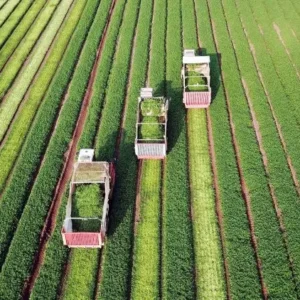
In Sioma District, Zambia, farming families are experiencing a major shift with the commissioning of the Malombe Centre Pivot Irrigation Scheme. President Hakainde Hichilema inaugurated the 25‑hectare system, which draws water from the Zambezi River to provide reliable, year‑round irrigation for 73 households in the IMIKAYA Cooperative. For the first time, these farmers can plan and produce beyond the limits of the rainy season, reducing uncertainty and strengthening food security.
The scheme is part of the Strengthening Climate Resilience of Agricultural Livelihoods in Agro‑Ecological Regions I and II in Zambia (SCRALA) project, funded by the Green Climate Fund and implemented by the Ministry of Agriculture with technical support from UNDP, FAO, WFP, and other national agencies. Delivered across 16 districts, the project promotes climate‑smart agriculture, improved water systems, climate information services, and enhanced market access, reaching nearly a million people nationwide.
In addition to irrigation, SCRALA has introduced early warning systems with weather stations and rain gauges, conservation agriculture practices, and centres of excellence where farmers learn adaptive techniques. Alternative livelihoods such as goat rearing, fish farming, and beekeeping provide additional income streams, while village savings groups—largely led by women—help households build financial resilience.
To reduce post‑harvest losses and strengthen market access, bulking centres have been established in districts such as Kazungula, Mambwe, and Nyimba, connecting farmers to structured markets and school feeding programmes. Other irrigation schemes, including the solar‑powered Tauya project in Chirundu, are already supporting year‑round cultivation and incomes. Malombe Irrigation is the latest addition, designed as part of an integrated value chain that links farmers from seed to sale.
The initiative is anchored in community ownership, with the IMIKAYA Cooperative actively managing the scheme. A Memorandum of Understanding with government, UNDP, the Barotse Royal Establishment, and private partners ensures technical support and market linkages for long‑term sustainability.
Beyond immediate benefits, the scheme is expected to stimulate the district economy by creating opportunities for agro‑processing, transport, and trade, while stable household incomes improve food security, education, and reinvestment in farming. For Zambia, such investments represent a broader transition toward climate‑resilient, commercially driven agriculture, reducing risks from drought and rainfall variability and enabling smallholder farmers to compete more effectively in national and regional markets.