• Skip to primary navigation
  • Skip to main content
  • Skip to primary sidebar

fundsforNGOs News

Grants and Resources for Sustainability

  • Subscribe for Free
  • Premium Support
  • Premium Sign in
  • Premium Sign up
  • Home
  • Grants & Funding
    • Funds for NGOs
      • Agriculture, Food & Nutrition
      • Animals and Wildlife
      • Arts & Culture
      • Children
      • Civil Society
      • Community Development
      • Democracy and Good Governance
      • Economic Development
      • Education
      • Disability
      • Employment and Labor
      • Environment
      • Family Support
      • Healthcare
      • HIV and AIDS
      • Housing & Shelter
      • Humanitarian Relief
      • Human Rights
      • Human Service
      • Information Technology
      • Livelihood Development
      • LGBTQIA2S+
      • Media and Development
      • Narcotics, Drugs and Crime
      • Old Age Care
      • Peace & Conflict Resolution
      • Poverty Alleviation
      • Refugees, Migration & Asylum Seekers
      • Science & Technology
      • Sports & Development
      • Sustainable Development
      • Water, Sanitation & Hygiene (WASH)
      • Women & Gender
      • Youth & Adolescents
    • Donors & Funders
    • Funds for Companies
      • Accounts & Finance
      • Agriculture, Food and Nutrition
      • AI
      • Education
      • Energy
      • Environment
      • Healthcare
      • Innovation
      • Manufacturing
      • Media
      • Research
      • Startups & Early-Stage
      • Sustainable Development
      • Technology
      • Travel & Tourism
      • Women
      • Youth
    • Funds for Individuals
  • Funds in Your Country
  • Proposal Writing
    • Sample Proposals
    • Agriculture Proposals
    • Business Proposals
    • Child Development Proposals
    • Climate Change & Biodiversity Proposals
    • Community Development Proposals
    • Democracy & Good Governance Proposals
    • Disability Proposals
    • Disaster & Humanitarian Relief Proposals
    • Environment Proposals
    • Education Proposals
    • Healthcare Proposals
    • Housing & Shelter Proposals
    • Human Rights Proposals
    • Livelihood Development Proposals
    • Nutrition & Food Security Proposals
    • Poverty Alleviation Proposals
    • Refugees, Migration & Asylum-Seekers’ Proposals
    • Rural Development Proposals
    • Sustainable Development Proposals
    • Water, Sanitation & Hygiene (WASH) Proposals
    • Women & Gender Proposals
    • Youth Development Proposals
  • Premium
    • Premium Sign-in
    • Premium Grants
    • Premium eBooks
    • Premium Webinars
    • Premium Videos
    • Premium Courses
    • Premium Support
  • NGOs.AI
  • Contact
    • Submit Your Opportunity
    • Learning Lab
    • Q&A
    • News
    • About us
You are here: Home / cat / Global Update: South Sudan Ceasefire Call, Ukraine Strikes, Gaza Food Alert

Global Update: South Sudan Ceasefire Call, Ukraine Strikes, Gaza Food Alert

Dated: March 11, 2026

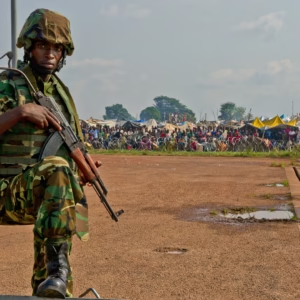
The UN High Commissioner for Human Rights has called for an immediate ceasefire in South Sudan, warning that violence has caused significant civilian casualties in recent weeks. Over the past 17 days alone, more than 160 civilians have reportedly been killed. Among the dead were at least 139 people who were killed on 1 March by fighters from the Bul Nuer ethnic group in the northern Ruweng administrative area, highlighting the severity of the escalating violence.

Further allegations point to serious abuses by government forces. According to the High Commissioner, 21 civilians were killed on 21 February in Pankor village in eastern Jonglei state after soldiers reportedly gathered villagers under the pretense of distributing food aid before opening fire on them. Such actions, he warned, could amount to war crimes. Since December, fighting between government and opposition forces and their allied militias has spread across several states, displacing more than 280,000 people, particularly in Jonglei.

In Ukraine, large-scale missile and drone strikes have recently killed and injured civilians while damaging key infrastructure. UN officials reported that attacks between last Thursday and Monday affected multiple regions, with Kharkiv among the hardest hit. Apartment buildings, a school and other civilian structures were damaged, leaving several people dead or wounded, including children.

Civilian casualties were also reported in Ukraine-controlled areas of the Donetsk region, particularly around Kramatorsk. The strikes damaged ambulances, fire trucks, homes and critical energy and railway infrastructure. UN officials stressed that despite the emergence of new global crises, the war in Ukraine continues to cause significant suffering and must not be overlooked. Humanitarian agencies are providing emergency assistance and have recently delivered supplies to around 1,000 residents in frontline communities in Donetsk.

Meanwhile, the UN World Food Programme has warned that many Palestinians in Gaza continue to face hunger due to limited humanitarian aid entering the territory. Although Israeli authorities reopened the Kerem Shalom crossing following the outbreak of conflict with Iran, aid deliveries remain severely restricted. As a result, humanitarian assistance is reaching people at only minimal levels, leaving the food security situation extremely fragile despite some improvement since the ceasefire began in October.

WFP currently has enough supplies to provide about two weeks of half rations for roughly 1.5 million people in Gaza after previously reducing full rations earlier this year. Aid officials say they hope to increase rations to around 75 percent of normal levels, but current restrictions on food deliveries make this unlikely. Despite the ceasefire agreement between Israel and Hamas, ongoing violence along the line of control continues to threaten both civilians and humanitarian operations.

In Afghanistan, the UN refugee agency has warned that escalating conflicts in the Middle East could trigger further returns of Afghan migrants from neighbouring countries under difficult conditions. Although the border with Iran currently appears calm, tensions are rising and movements may increase soon. Around 110,000 Afghans have already returned from Iran since the beginning of the year, including approximately 1,700 people each day following recent regional tensions.

Over the past two years, more than five million Afghans have returned from neighbouring countries, with nearly 1.9 million returning from Iran in 2025 alone. Many families have experienced repeated displacement, having first fled Afghanistan, then been displaced again within Iran, and now returning once more to uncertain conditions in their home country.

UNICEF has warned that the increasing number of returnees could create serious risks for children. Many families arriving at border crossings such as Islam Qala are exhausted and distressed after difficult journeys, often uncertain about their future. Nearly three million Afghans returned from neighbouring countries in 2025, and around 60 percent of them were families with children.

Children who are separated from their caregivers face particularly high risks of violence and exploitation. During the peak of returns last year, UNICEF assisted more than 8,000 unaccompanied and separated children arriving from Iran and Pakistan. Humanitarian agencies are now preparing to expand support at border crossings and in return areas, providing essential services such as healthcare, vaccinations, nutrition screening, clean water and child protection.
Related Posts

  • Israeli Military’s Broad Evacuation Orders in Lebanon Fuel Panic, Suffering
  • World News: Myanmar Airstrikes, South Sudan Violence, Afghan Women’s Rights
  • Lebanon Crisis Deepens as 700,000+ People Displaced, IRC Warns
  • Lebanon Crisis: Causes, Impact, and How You Can Help
  • Cyberbullying on the Rise: Two-Thirds of Children Report Alarming Increase

Primary Sidebar

Latest News

Personalised mRNA Cancer Vaccine Shows Promise in Preventing Melanoma Recurrence

AI for Good: How the UN Uses Artificial Intelligence to Advance Human Rights

UN Launches Initiative to Protect Terrorism Victims From Online Harm

Serbian Company Tira Switches to Solar Energy with EBRD and EU Support

Lebanon Infrastructure Projects Create Jobs and Improve Public Services

South Africa Advances R2 Trillion Infrastructure Pipeline as Municipal Projects Gain Support

South Africa Strengthens Infrastructure Partnerships to Accelerate Project Delivery

Mauritius Expands Rooftop Solar Programme with 400 Apartments in Henrietta

South Korea Donates $3 Million to WFP for Food and Nutrition Aid in Afghanistan

Tanzania’s Investment Funds Reach $2 Billion as Savings Flow Into Government Debt

Kabanga Nickel Project Attracts $500 Million U.S.-Backed Investment Interest

African Development Bank and ECCAS Strengthen Partnership for Central African Integration

Barbados Strengthens Responsible Suicide Reporting Through Media Training

IOM Calls for Investment in Land Restoration to Reduce Displacement

IFC and Banco Consorcio Expand Housing Finance in Chile

IFC and BBVA Mexico Launch $103.5 Million Risk Transfer to Expand SME Financing

IFC and Bank Center Credit Expand Trade Finance for Kazakhstan Businesses

ADB Private Sector Financing Reaches $9.5 Billion in 2025

ADB Launches $2 Billion Initiative to Combat Land Degradation in Asia-Pacific

Community-Driven Programs Expand Healthcare and WASH Support Across Africa

Assam Flood Relief Must Go Beyond Food and Shelter to Protect Children

Child Participation: Why Every Child’s Voice Matters in Building a Better India

Jamaica’s Digital Future Begins in the Classroom

Virginia Governor Urges Families to Apply for SUN Bucks Before August 31 Deadline

EBRD and EU Support Cleaner, Safer Waste Management for 800,000 People in Serbia

EBRD and Partners Exit Graphwise Investment in Bulgaria

El Niño Could Displace Up to 3 Million People in East Africa by Year-End

South Africa and Zimbabwe Expand Bilateral Cooperation

UNDP Calls for More Accessible Legal Aid for Forcibly Displaced People

Green Climate Fund Backs New Platform to Scale Green Investment in Mongolia

Children’s Digital Rights Need More Than a False Promise of Safety

Bangladesh: 35% of Rohingya Refugees Face Crisis or Emergency Hunger

IUCN and UNEP Announce $7.5 Million in Grants for Ecosystem-Based Adaptation

Pile of US $100 bills with a banner reading 'Spend, Spend, Spend?'.

CEPF Invests $3.9 Million in Biodiversity Conservation Across Indo-Burma

IUCN and CGIAR Strengthen Partnership for Nature-Positive Land and Food Systems

Africa Calls for Community-Led Land Restoration to Build Climate Resilience

Global Land Restoration Advances, but Only 10% of Pledges Delivered: IUCN

IUCN and CREEI Launch Project for Sustainable Renewable Energy Systems

Lao PDR Strengthens Biodiversity Conservation Through Science and Partnerships

Southeast Michigan Nonprofits Receive $2 Million Boost to Strengthen Community Support

Funds for NGOs
Funds for Companies
Funds for Media
Funds for Individuals
Sample Proposals

Contact us
Submit a Grant
Advertise, Guest Posting & Backlinks
Fight Fraud against NGOs
About us

Terms of Use
Third-Party Links & Ads
Disclaimers
Copyright Policy
General
Privacy Policy

Premium Sign in
Premium Sign up
Premium Customer Support
Premium Terms of Service

©FUNDSFORNGOS LLC.   fundsforngos.org, fundsforngos.ai, and fundsforngospremium.com domains and their subdomains are the property of FUNDSFORNGOS, LLC 1018, 1060 Broadway, Albany, New York, NY 12204, United States.   Unless otherwise specified, this website is not affiliated with the abovementioned organizations. The material provided here is solely for informational purposes and without any warranty. Visitors are advised to use it at their discretion. Read the full disclaimer here. Privacy Policy. Cookie Policy.