• Skip to primary navigation
  • Skip to main content
  • Skip to primary sidebar

fundsforNGOs News

Grants and Resources for Sustainability

  • Subscribe for Free
  • Premium Support
  • Premium Login
  • Premium Sign up
  • Home
  • Funds for NGOs
    • Agriculture, Food and Nutrition
    • Animals and Wildlife
    • Arts and Culture
    • Children
    • Civil Society
    • Community Development
    • COVID
    • Democracy and Good Governance
    • Disability
    • Economic Development
    • Education
    • Employment and Labour
    • Environmental Conservation and Climate Change
    • Family Support
    • Healthcare
    • HIV and AIDS
    • Housing and Shelter
    • Humanitarian Relief
    • Human Rights
    • Human Service
    • Information Technology
    • LGBTQ
    • Livelihood Development
    • Media and Development
    • Narcotics, Drugs and Crime
    • Old Age Care
    • Peace and Conflict Resolution
    • Poverty Alleviation
    • Refugees, Migration and Asylum Seekers
    • Science and Technology
    • Sports and Development
    • Sustainable Development
    • Water, Sanitation and Hygiene (WASH)
    • Women and Gender
  • Funds for Companies
    • Accounts and Finance
    • Agriculture, Food and Nutrition
    • Artificial Intelligence
    • Education
    • Energy
    • Environment and Climate Change
    • Healthcare
    • Innovation
    • Manufacturing
    • Media
    • Research Activities
    • Startups and Early-Stage
    • Sustainable Development
    • Technology
    • Travel and Tourism
    • Women
    • Youth
  • Funds for Individuals
    • All Individuals
    • Artists
    • Disabled Persons
    • LGBTQ Persons
    • PhD Holders
    • Researchers
    • Scientists
    • Students
    • Women
    • Writers
    • Youths
  • Funds in Your Country
    • Funds in Australia
    • Funds in Bangladesh
    • Funds in Belgium
    • Funds in Canada
    • Funds in Switzerland
    • Funds in Cameroon
    • Funds in Germany
    • Funds in the United Kingdom
    • Funds in Ghana
    • Funds in India
    • Funds in Kenya
    • Funds in Lebanon
    • Funds in Malawi
    • Funds in Nigeria
    • Funds in the Netherlands
    • Funds in Tanzania
    • Funds in Uganda
    • Funds in the United States
    • Funds within the United States
      • Funds for US Nonprofits
      • Funds for US Individuals
      • Funds for US Businesses
      • Funds for US Institutions
    • Funds in South Africa
    • Funds in Zambia
    • Funds in Zimbabwe
  • Proposal Writing
    • How to write a Proposal
    • Sample Proposals
      • Agriculture
      • Business & Entrepreneurship
      • Children
      • Climate Change & Diversity
      • Community Development
      • Democracy and Good Governance
      • Disability
      • Disaster & Humanitarian Relief
      • Environment
      • Education
      • Healthcare
      • Housing & Shelter
      • Human Rights
      • Information Technology
      • Livelihood Development
      • Narcotics, Drugs & Crime
      • Nutrition & Food Security
      • Poverty Alleviation
      • Sustainable Develoment
      • Refugee & Asylum Seekers
      • Rural Development
      • Water, Sanitation and Hygiene (WASH)
      • Women and Gender
  • News
    • Q&A
  • Premium
    • Premium Log-in
    • Premium Webinars
    • Premium Support
  • Contact
    • Submit Your Grant
    • About us
    • FAQ
    • NGOs.AI
You are here: Home / cat / Food Value Chain Losses: Where Food Is Wasted and How to Save It

Food Value Chain Losses: Where Food Is Wasted and How to Save It

Dated: April 17, 2026

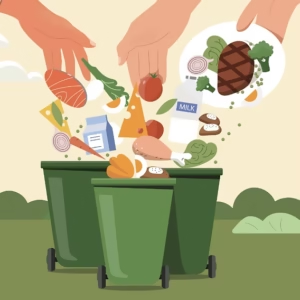
In a warehouse on the outskirts of a city, crates of fresh produce arrive before dawn, but not all of it reaches consumers. Some items are damaged during transport, some remain unsorted for too long, and a portion is ultimately discarded. These losses, though often small at each step, accumulate across the food system and represent a significant global challenge.

Food loss and waste typically occur quietly across multiple decision points in the food supply chain, including when to harvest, how to store produce, what is acceptable for sale, and what is discarded. By the time food reaches consumers, it has already passed through a series of processes where inefficiencies and system gaps contribute to its loss.

To address this issue, the Food and Agriculture Organization of the United Nations (FAO) has launched a new open-access course titled “Tackling Food Loss and Waste across the Agrifood Systems” through its Virtual Learning Center. The course is designed to help learners understand where and why food loss occurs and how it can be reduced across different stages of the agrifood system.

Developed by FAO’s Regional Office for Europe and Central Asia in partnership with the International Food Waste Coalition programme under WRAP Europe, the course follows the food journey from production to processing, retail, and food service. It examines key causes of loss at each stage, such as production timing and market demand shifts, rejection of edible food due to strict standards in processing, and inefficiencies in forecasting, storage, and portioning in retail and hospitality.

FAO officials emphasize that reducing food loss requires more than measurement alone. It also demands practical action based on evidence. The course is designed to support this transition by helping practitioners identify root causes, apply solutions, and track progress over time using data-driven approaches.

The course incorporates established global methodologies, including FAO and UNEP frameworks and the Food Loss and Waste Accounting and Reporting Standard, along with practical approaches such as Target-Measure-Act. It provides tools, case studies, and real-world examples to help users assess economic and environmental impacts and implement solutions across the supply chain, including in hotels, restaurants, and catering services.

Co-developed and peer-reviewed by technical experts, the programme was pilot-tested in 2025 with 171 participants from 11 countries across Europe, Central Asia, the Caucasus, and Türkiye. Participants included farmers, processors, retailers, policymakers, and civil society actors, all working to understand and address food loss challenges in their respective roles.

The course is freely accessible worldwide and can be taken sequentially or used as a reference tool. Rather than offering a single solution, it provides practical guidance to help stakeholders measure, understand, and gradually reduce food loss and waste across the global food system.

Related Posts

  • Senegal Tackles Food Waste with FAO-Supported Touba Project
  • Senegal: FAO Boosts Efforts to Cut Post-Harvest Losses
  • WFP Launches HungerMap Live for Real-Time Hunger Intelligence
  • IFAD Warns Middle East Conflict Threatens Global Food Security and Rural Supply Chains
  • KSrelief $25 Million Boost Strengthens Food Security and Livelihoods in Yemen

Primary Sidebar

Latest News

Africa’s Clean Cooking Gap Leaves Nearly 1 Billion Without Access

Australians for Mental Health Welcomes $517 Million Disability Support Program

Malawi Flood Crisis: Heavy Rains Displace Tens of Thousands

Falconer Unveils Fresh Aid for Displaced Communities in Lebanon (EN/AR)

Sudan: NGOs Urge Action as Conflict Impacts Worsen Regionally

Lower-Income Countries Set Record Investment in Immunisation Programmes

UAE Plans Thousands of Jobs in Non-Profit Sector with Dh100M Fund

Funding Boost for Hundreds of Grassroots Groups to Unite Communities

EU Supports Ukrainian Civil Society Project to Strengthen Justice Reforms

UK and IFC Partner to Boost Agribusiness and Job Creation in the DRC

IFC, Santander Brazil Join Forces to Expand Eco Invest Sustainable Financing in Brazil

Africa Vaccine Manufacturing Boost: IFC, EIB Group and EU Support Biovac Expansion

FAO Hosts Indigenous Consultation in Suriname for REDD+ Climate Finance Readiness

FAO Urges Faster Action to Close Global Water and Sanitation Gaps

Food Value Chain Losses: Where Food Is Wasted and How to Save It

Senegal Tackles Food Waste with FAO-Supported Touba Project

FAO Report Highlights Women’s Role in Africa’s Agrifood Systems

Senegal: FAO Boosts Efforts to Cut Post-Harvest Losses

Ghana Boosts Vaccine Manufacturing Ambition with Clinical Trials

World Health Day 2026: How Nigeria Focused on People and Evidence

Amnesty Calls on Maldives to Scrap Death Penalty Bill

Amnesty Warns India’s Digital Media Rules May Enable Abusive Powers

Over 100 NGOs Dissolved in Burkina Faso Crackdown on Civil Society

Ontario Invests $57M in Indigenous Postsecondary Institutes

Her Voice Fund Evaluation Launched by Womankind

Learnings from a Trilateral Climate-Smart Agriculture Programme

New Funding Announced for Displaced Communities in Lebanon

Climate Change and Work: ILO Urges Stronger Social Protection

Japan SMEs Gain New ILO Business and Human Rights Case Studies

WFP Launches HungerMap Live for Real-Time Hunger Intelligence

KSrelief and WFP Provide Nutrition Aid to Families in Somalia

Bhutan School Nutrition Programme Launched by KOICA and WFP

Japan Donates $2 Million for Disaster Relief in Pakistan

Africa’s Growth at Risk as Middle East Crisis May Reduce GDP by 0.2%

Key Lessons from US Inflation Reduction Act for Future Clean Energy Tax Policy

EU and Partners Pledge €811 Million to Address Sudan Humanitarian Crisis

UK Awards £2 Million to Community Groups to Strengthen Unity Across England

Sudan Food Crisis 2026: Key Facts on Hunger, Agriculture Collapse, and Urgent Aid Needs

Measles Vaccines Save Nearly 20 Million Lives in Africa Since 2000

IFAD Joins World Bank’s Water Forward Initiative to Boost Water Security for 1 Billion People

Funds for NGOs
Funds for Companies
Funds for Media
Funds for Individuals
Sample Proposals

Contact us
Submit a Grant
Advertise, Guest Posting & Backlinks
Fight Fraud against NGOs
About us

Terms of Use
Third-Party Links & Ads
Disclaimers
Copyright Policy
General
Privacy Policy

Premium Sign in
Premium Sign up
Premium Customer Support
Premium Terms of Service

©FUNDSFORNGOS LLC.   fundsforngos.org, fundsforngos.ai, and fundsforngospremium.com domains and their subdomains are the property of FUNDSFORNGOS, LLC 1018, 1060 Broadway, Albany, New York, NY 12204, United States.   Unless otherwise specified, this website is not affiliated with the abovementioned organizations. The material provided here is solely for informational purposes and without any warranty. Visitors are advised to use it at their discretion. Read the full disclaimer here. Privacy Policy. Cookie Policy.