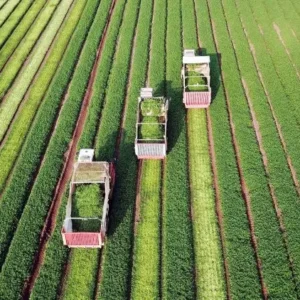
Meeting today’s agricultural challenges while preparing for the future requires giving farmers access to a diverse set of tools and solutions. Central to this effort is the Future Seeds genebank, managed by the Alliance of Bioversity International and CIAT, which functions as a global repository for plant materials that can adapt to changing environments and evolving production demands. By offering a broader range of crop options, the genebank enables farmers to select varieties that are better suited to their specific land and climate conditions.
In 2019, Dr. Hengfu Huan from CATAS visited the Tropical Forages Program to identify forage options suitable for Hainan’s agricultural systems. By leveraging the thousands of accessions in the genebank, Dr. Huan collected 800 different forage materials for evaluation. Following extensive trials, two high-performing species—Sesbania and Desmodium—were selected for their adaptability and productivity in local conditions.
The choice of these plants reflects the importance of cover crops in sustainable agriculture. Cover crops are grown not for harvest, but to protect and enrich the soil. When incorporated into the soil while still green or left on the surface as mulch, they act as green manure, returning vital nutrients and organic matter to the soil. This approach aligns with China’s national agricultural strategy, which promotes green manure as a key tool to reduce chemical fertilizer use. By relying on biological alternatives to maintain soil fertility and structure, the policy supports long-term productivity while protecting the environment from the negative impacts of synthetic inputs.