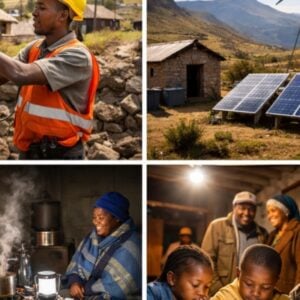
June 4, 2026 — Plateau State, Nigeria — In the agrarian town of Namu, rice miller Victoria Ali has seen her income grow thanks to stable electricity from a local solar minigrid. For years, unreliable power limited productivity and income opportunities for women and small businesses. Now, access to clean energy is transforming livelihoods and enabling women to step into leadership roles in rural economies.
Across sub-Saharan Africa, nearly 600 million people still live without electricity. The Africa Minigrids Program (AMP), UNDP’s largest sustainable energy initiative, is changing this reality. In Nigeria, AMP is investing US$5.9 million across 23 sites, bringing solar-powered minigrids to underserved communities. These projects align with Nigeria’s Electricity Act 2023 and Energy Transition Plan, while contributing to climate commitments under the Paris Agreement. The initiative is expected to mitigate 74,000 metric tons of CO2 by replacing diesel and fuelwood with solar energy.
By 2025, AMP had already electrified 14 communities across six geopolitical zones, improving daily life for over 20,000 people. Small businesses now enjoy reliable power for refrigeration, machinery, and extended working hours, boosting productivity and income.
A central focus of AMP is women’s empowerment. Access to energy reduces the burden of domestic work, supports climate-smart agribusiness, and opens opportunities for education and entrepreneurship. Yet, electrification efforts often overlook women’s specific energy needs due to entrenched patriarchal norms. AMP is addressing this gap through a Technical Working Group on Gender Equality, ensuring women are included in design, financing, and governance of minigrid projects.
Women leaders like Habiba Ali, CEO of Sosai Renewable Energy, are driving change. Sosai manages two AMP sites delivering 100 kilowatts of power to 600 households. Habiba believes women can be the new face of the energy sector: “People need to hear our voices and see that women are here.”
Scaling minigrids requires robust data infrastructure. AMP is building national and regional digital platforms with LocateIT, enabling real-time monitoring, financing verification, and investor confidence. UNDP modeling shows minigrids are the lowest-cost pathway to electrify 265 million people by 2030, representing a $46 billion market opportunity.
For women like Victoria, access to sustainable energy is more than electricity — it is a pathway to economic leadership, resilience, and inclusion. As AMP expands, it is powering not just homes and businesses, but a more equitable future across Africa.