
The Clean Energy Electric Boat Innovation Expo held on Tunda Island highlighted how solar-powered electric boats can support small-scale fishers by reducing fuel costs, lowering emissions, and strengthening livelihoods amid climate change. Convened by UNDP and Indonesia’s National Research and Innovation Agency (BRIN), the event demonstrated practical clean energy solutions tailored to the needs of… [Read More]
Bridging the Gender Gap: Three Key Pathways Strengthening EU–India Cooperation

India’s rapid economic growth and strategic importance have made it a key partner for the European Union, with renewed momentum in EU–India relations following the adoption of a Joint Communication in September 2025. This agenda spans trade, technology, security and connectivity, while negotiations on the long-awaited EU–India Free Trade Agreement are nearing completion. This phase… [Read More]
Eliminating Extreme Poverty: Lessons from Kerala for ASEAN Countries
When Kerala’s Chief Minister announced on 1 November 2025 that the state had eliminated extreme poverty, it drew attention both nationally and internationally. While debates over definitions and measurement emerged, most observers acknowledged that Kerala had successfully addressed severe deprivation by ensuring access to nutrition, healthcare, and education. The focus quickly turned to understanding how… [Read More]
Youth-Led Social Ventures in Korea: Current Landscape and Opportunities

The study aims to provide a comprehensive analysis of Korea’s youth social entrepreneurship ecosystem and derive actionable policy recommendations. A secondary objective is to present Korea’s entrepreneurship policies as a reference framework for other countries seeking to strengthen their own ecosystems. While Korea’s policies have limitations and may not be directly transferable due to differing… [Read More]
Rethinking AI Adoption: Strategic Lessons from Five Enterprise AI Failures

Across five industries—banking, healthcare, software, legal services, and retail—AI transformation efforts repeatedly failed despite enthusiasm and leadership support. These failures, while diverse in context, reflected predictable patterns rooted in structural, cultural, and strategic misalignment. Leaders often underestimated the complexity of integrating AI and overestimated readiness across teams and systems. In banking, data fragmentation and regulatory… [Read More]
How Catalytic Capital Creates Real-World Impact
The practice of impact measurement and management (IMM) is crucial to the impact investment field, yet inherently complex. While investors can leverage a growing body of tools and expertise, challenges remain in effectively aggregating, attributing, and analyzing impact. Over the past year, MacArthur’s development of its IMM report on the Catalytic Capital Consortium (C3) investments… [Read More]
PIDG Invests $3.3M in Kenyan Waste-to-Energy Expansion Driving Africa’s Circular Economy
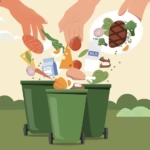
The Private Infrastructure Development Group (PIDG) has invested $3.3 million to support the expansion of Sanivation’s waste-to-energy facility in Naivasha, Kenya, marking a key milestone in promoting circular economy solutions across East Africa. The investment, channeled through PIDG’s project development arm InfraCo, is complemented by a $500,000 technical assistance grant to strengthen operational capacity and… [Read More]
Leading the Way: How a Key South Sumatran Official is Advancing Indonesia’s Green Energy Goals

South Sumatra Province in Indonesia is actively shifting from coal dependence toward a greener economy centered on skilled workers and sustainable economic opportunities. To support this transformation, the province established the Regional Consultation Forum (FKD) for Accelerating Economic Transformation, bringing together government, employers, trade unions, universities, civil society, and the media to jointly shape the… [Read More]
How Nepal Strengthens Child Labour-Free Zones with Frontline Worker Training

Nepal continues to face a serious challenge in eliminating child labour, with national estimates indicating that 1.1 million children are engaged in work, including 220,000 in hazardous occupations. Despite progress, child labour persists in sectors such as brick kilns, woollen carpets, and entertainment, highlighting the need for stronger, coordinated action across all levels of government…. [Read More]
How Local Procurement Can Drive Growth in Ghana’s Garment Sector

Ghana’s garment sector is currently valued at around US$400 million, with the government aiming to grow it to over US$2 billion and create 150,000 jobs by 2033, alongside expanding cotton production across 50,000 hectares. Despite this potential, more than 70 percent of textiles and garments consumed in the country are imported annually, limiting the sector’s… [Read More]
How Montenegrin Companies Are Turning Climate Goals into Business Gains
Montenegro’s green transition is increasingly influencing how businesses compete, invest, and create jobs. For employers, sustainability is no longer just a regulatory obligation—it is emerging as a driver of resilience, market access, and long-term growth. Companies that strategically adopt climate-conscious practices can gain commercial advantages while mitigating risks associated with regulatory changes, shifting investor expectations,… [Read More]
World Bank Supports Laos in Advancing Education and Healthcare Systems

The World Bank has approved a $35 million, six-year project in Laos aimed at improving the performance of frontline workers in education and health. The initiative, titled Improving Frontline Workers Performance in Education and Health, seeks to address long-term human capital challenges by enhancing staff management, professional development, and training systems. In the education sector,… [Read More]
West Bengal Healthcare Boost: World Bank Funding for Better-Quality Services

The World Bank has approved $286 million in financing for a program aimed at improving healthcare access and quality for over 90 million people in West Bengal. The initiative seeks to enhance life expectancy and quality of life by addressing both service gaps and systemic constraints in the state’s health system. West Bengal has achieved… [Read More]
Crisis in Sudan: Conflict and Hunger Worsen Amid WFP Funding Shortfalls
Sudan has endured over 1,000 days of brutal conflict, creating the world’s largest hunger and displacement crisis, with no immediate end in sight. The United Nations World Food Programme (WFP) has reached more than 10 million of the most vulnerable women, men, and children since the resurgence of civil conflict in April 2023, providing emergency… [Read More]
IDB Issues £1 Billion Fixed-Rate Benchmark Bond for Development Financing

The Inter-American Development Bank (IDB) has completed a £1 billion fixed-rate benchmark bond issuance, marking its largest-ever transaction in sterling and its first benchmark issuance in the currency for 2026. Investor demand for the bond exceeded £2.2 billion, more than double the amount issued, reflecting strong confidence in the Bank’s credit quality and its long-standing… [Read More]
$30 Million Deal: ADB, Masdar Expand Solar Energy and Storage in Uzbekistan

The Asian Development Bank (ADB) and Abu Dhabi Future Energy Company (Masdar) have signed a $30 million financing package to develop a 300-megawatt solar power plant and a 75-megawatt-hour battery energy storage system in Guzar City, Kashkadarya Region, Uzbekistan. The project will also include 1.6 kilometers of transmission lines and a 220-kilovolt substation to integrate… [Read More]
Champhira Agriculture Revolution: How Women and Youth Are Leading Change

In Champhira, Mzimba, young farmers like Levi Kaunda are learning life lessons from bees while building livelihoods. As a member of the Zandonda and Tupwenge cooperatives, Levi carefully tends to honeycombs, seeing bees as models of hard work, calm, and collaboration. His perspective reflects a broader transformation enabled by the Empowering Women and Youth in… [Read More]
Hunger vs. Funding: Part 2 – How Investment Can End Food Insecurity

In Haiti, Hurricane Melissa devastated the coastal town of Petit-Goâve, destroying homes, livelihoods, and taking lives. Families lost livestock, suffered injuries, and experienced unimaginable grief, with rivers bursting and mud burying entire communities. The storm highlighted the devastating consequences of underfunded humanitarian aid in a country where more than half the population is acutely food… [Read More]
Hunger vs. Funding: How Investment Can End Food Insecurity

As 2026 begins, sharp cuts in humanitarian assistance are leaving deep and sometimes irreversible impacts on the world’s most vulnerable communities. The World Food Programme (WFP) posed a question to its country directors in emergency hotspots: what if funding were sufficient to not only save lives but transform them? In the Democratic Republic of the… [Read More]
From Tradition to Transformation: How Kamara Women Built Sustainable Livelihoods

Forty-five women from Kamara Town never imagined that they could collectively manage thousands of dollars or own such wealth as a group. In Kpo-River, rural Montserrado County, a seed capital of $2,000 USD in 2025 launched the community’s first Village Saving and Loan Association (VSLA). Within the first year, the women raised 769,655 Liberian Dollars,… [Read More]
Localization in Africa: Lessons from Kenya and Senegal
In early July, a long-feared reality materialized for millions in the development aid ecosystem when the United States Agency for International Development (USAID) ceased operations. As the world’s largest single aid donor, disbursing around $72 billion in 2023 and accounting for over 40 percent of UN-tracked humanitarian aid in 2024, USAID’s absorption into the U.S…. [Read More]
Zambia’s Path to Fertilizer Self-Sufficiency: Boosting Agricultural Growth
When the Russia-Ukraine conflict erupted in February 2022, global supply chains were disrupted, sending shockwaves through Africa’s agricultural sector. In Zambia, farmers faced skyrocketing fertilizer prices and dwindling supplies, threatening their livelihoods. The country relied heavily on imports from Russia and Ukraine, spending over $110 million annually, yet in 2022, it required 632,529 metric tonnes… [Read More]
Biopesticides at Scale: Lessons from India’s FARM Project
This case study examines how farmer training under India’s Financing Agrochemical Reduction and Management (FARM) project is enabling a large-scale transition toward safer and more sustainable agricultural practices. Led by the United Nations Environment Programme (UNEP) and funded by the Global Environment Facility (GEF), the initiative promotes reduced reliance on harmful chemicals and plastics by… [Read More]


