
Ms. Tesfai recounted her experience of digital stalking during a UN event in New York commemorating the International Day for the Elimination of Violence against Women. What began as anonymous online interactions escalated into physical stalking, with the perpetrator sending messages describing what she was wearing. Despite reporting the threats to the police, she was… [Read More]
Global Crisis: More Than 600 Million Children Face Domestic Violence, UNICEF Reports

UNICEF has warned that over 600 million children worldwide are exposed to violence at home, with the highest rates in Oceania, sub-Saharan Africa, and Central and Southern Asia. These figures reflect deep regional inequalities and the widespread abuse that women face globally. UNICEF Executive Director Catherine Russell emphasized that the safety and autonomy of women… [Read More]
IDB Supports Uruguay in Strengthening National Road Infrastructure

WASHINGTON — The Inter-American Development Bank (IDB) has approved a Conditional Credit Line for Investment Projects (CCLIP) of $675 million to support a program designed to optimize public spending, improve road asset management, and preserve Uruguay’s National Road Network (RVN). The initiative aims to strengthen infrastructure planning, ensure financial sustainability, and enhance the overall efficiency… [Read More]
WHO Africa Approves Strategic Roadmap for Safeguarding Communities During Health Crises

Pretoria—The World Health Organization (WHO) in the African region, together with Member States and partners, has endorsed a regional roadmap to protect communities during public health emergencies. This initiative marks the first time the region has formally established systems holding both governments and WHO jointly accountable for preventing and addressing sexual misconduct in their operations…. [Read More]
Building Climate-Resilient Communities: Southern Africa Advances Anticipatory Action
Since the 1980s, Southern Africa has faced increasingly frequent and severe disasters, including droughts, cyclones, floods, and health crises. These repeated shocks have intensified displacement, food insecurity, and community vulnerability, highlighting the need for proactive, integrated, and locally anchored anticipatory action systems that respond to the realities of affected populations. This approach has gained high-level… [Read More]
Floods in Southern Thailand Affect Hundreds of Thousands of Children, Claim Three Lives

Thailand is facing some of its worst flooding in a generation, with severe impacts across the southern provinces. Schools in the 12 most affected provinces have been shut indefinitely, and communities are struggling with rising floodwaters, power outages, and displacement. Save the Children has warned that children are at serious risk of electrocution from downed… [Read More]
Strengthening Serbia’s Food Systems: UN Initiative Marks a Year of Progress

The United Nations joint programme “From Seed to Sustainability: Food Systems 4 All” concluded in August 2025, marking a significant step forward in Serbia’s efforts to build resilient, inclusive, and sustainable food systems. Running from July 2024 to August 2025, the initiative fostered cooperation across institutions and communities, introduced innovative food production models, and placed… [Read More]
Ending Violence Against Women and Girls: IOM Urges Worldwide Commitment

Geneva, 25 November 2025 – As the world begins the 16 Days of Activism against Gender-Based Violence (GBV), the International Organization for Migration (IOM) is calling on governments, humanitarian actors, and communities to strengthen efforts to prevent, address, and ultimately eliminate violence against women and girls globally. IOM emphasizes the urgency of placing women and… [Read More]
Peru’s UNESCO Initiative Promotes Safe Digital Spaces with “UNITE” Campaign
UNESCO Peru has launched the campaign “For a Web Without Violence” as part of the International Day for the Elimination of Violence against Women, joining the United Nations global initiative “UNITE to End Violence against Women and Girls.” The campaign seeks to address the rising threat of digital violence, which affects women and girls at… [Read More]
€1 Billion Infrastructure Loans to Be Distributed by FIFA and Saudi Arabia

FIFA and the 2034 World Cup host, Saudi Arabia, have announced a plan to distribute up to $1 billion in concessional loans aimed at supporting sports infrastructure in developing nations. The initiative, formalized through a memorandum of understanding with the Saudi Fund for Development (SDF), will finance the construction or enhancement of FIFA-certified stadiums and… [Read More]
European Contribution Reductions Put Global Fund at Risk

Several European governments have announced cuts to the Global Fund at a recent fundraising summit in South Africa, signaling a shift away from their historically strong support for global health initiatives. The European Union did not commit to a specific amount, as negotiations for its long-term budget for 2028–2034 are still ongoing, meaning the total… [Read More]
Ending Online Violence: Protecting Women and Girls in the Digital Age

Digital technologies and artificial intelligence (AI) offer transformative potential for human development and the achievement of Sustainable Development Goals, yet they also create new risks that disproportionately affect women and girls. From deepfakes to coordinated online harassment, digital violence amplifies existing gender-based abuse while introducing new forms of harm. These threats intersect with broader global… [Read More]
England’s Wildlife at Risk: Conservation Leaders Warn of a ‘Perfect Storm’

Two of the UK’s largest conservation charities, the RSPB and The Wildlife Trusts, have issued a stark warning that the UK Government’s “Build Baby Build” agenda is creating a perfect storm for nature, putting wildlife and habitats at risk. The organisations stress that this approach runs counter to widespread public support for protecting the natural… [Read More]
How Emerging Countries’ Innovations Drive Global Climate Resilience

A new global development paradigm, the climate resilience transition, is emerging in response to the increasing frequency and severity of climate hazards such as floods, heatwaves, storms, droughts, and forest fires. While development finance institutions (DFIs) and development aid agencies (DAAs) support climate resilience projects, a significant portion of the market opportunity for private-sector innovation… [Read More]
From Cost to Investment: Advancing Health Equity for People with Disabilities

Around 1.3 billion people with disabilities continue to face substantial health inequities, many of which are rooted in how health systems are financed. High out-of-pocket costs, limited benefit packages, and insufficient funding for accessibility and reasonable accommodations prevent many from accessing essential health services. To mark the International Day of Persons with Disabilities, the International… [Read More]
Promoting Fair Labor Practices: Thailand’s Strategy for Competitive Trade

Bangkok (ILO News) — Thailand is increasingly linking trade policy with decent work principles to enhance long-term competitiveness, especially amid global trade uncertainty and volatility. A national policy dialogue held on 25 November 2025, titled “Decent Work and Trade Readiness: Harnessing Thailand’s Potential for Global Competitiveness in the Era of Changing Trade Patterns,” brought together… [Read More]
Practical Strategies for Decent Work in Supply Chains by Multinational Cooperatives
GENEVA — A joint webinar organized by the ILO’s Cooperative, Social and Solidarity Economy (COOP/SSE) Unit, the International Cooperative Alliance (ICA), and the International Cooperative Entrepreneurship Think Tank (ICETT) highlighted how large and multinational cooperatives advance decent work across global supply chains. The event brought together cooperative leaders, experts, and practitioners to share operational tools,… [Read More]
Enhancing Learning in Cambodia: How Full-Day Primary School Schedules Can Improve Student Performance
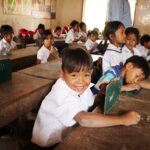
Cambodia’s primary education curriculum allocates a relatively high proportion of time to literacy and numeracy, indicating that curriculum design itself is not the main barrier to student learning. However, actual instruction time is significantly lower than the prescribed 728 hours due to instruction time loss, which some studies estimate could be as high as a… [Read More]
Improving Teaching Quality and Instruction Time to Boost Primary Education in Cambodia

PHNOM PENH, November 25, 2025 — Cambodia has made significant progress in enrolling children in school, but urgent improvements are needed in classroom teaching, according to two new World Bank reports. The studies examine both the quality and quantity of instruction in primary schools and provide recommendations to strengthen basic literacy and numeracy, ensuring all… [Read More]
Cambodia’s Primary Education Reform: Enhancing Teaching Quality and Performance Incentives
Cambodia’s primary education sector has seen a significant rise in the attractiveness of the teaching profession, with a notable increase in high-caliber candidates applying for teaching positions. Between 2014 and 2024, half of the teacher trainees came from the top decile of Grade 12 examinees. Public primary school teacher salaries, adjusted for inflation, more than… [Read More]
ADB Supports Armenia’s Power Grid Modernization to Boost Energy Security

In the early 1990s, Armenia faced a severe energy crisis following the collapse of the Soviet Union and political tensions that disrupted energy supplies. The country’s only nuclear power plant, Metsamor, had been halted after the 1988 Spitak earthquake, leaving Armenia almost entirely dependent on hydropower. Widespread blackouts paralyzed industries and households, with electricity available… [Read More]
Financial Intermediary Fund Established to Support Gaza’s Reconstruction and Development

Conflict in Gaza has caused severe damage to its people, infrastructure, and economy, creating enormous recovery needs that go beyond traditional post-conflict reconstruction. By mid-2025, total recovery and reconstruction requirements in Gaza exceeded $67 billion, according to the Addendum to the Interim Rapid Damage and Needs Assessment (IRDNA) led by the World Bank Group, the… [Read More]
World Bank: Creating Jobs Essential for Faster Poverty Reduction and Social Equality in Bangladesh

Bangladesh achieved significant progress in poverty reduction between 2010 and 2022, lifting 25 million people out of poverty and 9 million out of extreme poverty, while improving access to electricity, education, and sanitation. However, since 2016, the pace of poverty reduction has slowed, and economic growth has become less inclusive, according to the Bangladesh Poverty… [Read More]


