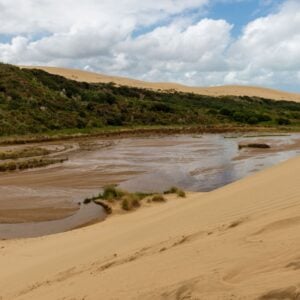
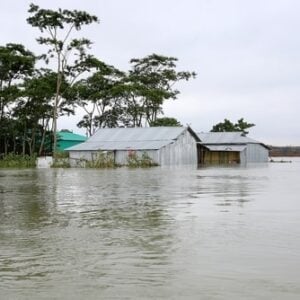
Water-spreading weirs are emerging as a vital solution for both Sudanese refugees and host communities in eastern Chad, where access to water and fertile land has become increasingly difficult. These concrete structures are designed to slow and manage excess rainwater by spreading floodwaters across surrounding land, allowing the water to soak into the ground rather than run off quickly. In drought-prone areas where rainfall is highly irregular, this helps recharge groundwater, improve soil moisture, restore fertility, and expand arable land, making it possible for crops to grow better and pastures for livestock to recover. For communities living in fragile and resource-scarce environments, these structures are proving to be a lifeline.
The need for such interventions has become more urgent since the renewed conflict in Sudan triggered a major refugee influx into Chad. Since April 2023, more than 917,000 Sudanese refugees have arrived in the country, often settling in areas where local populations are already struggling with limited water and land resources. Because agriculture is the main source of livelihood for both refugees and host communities, pressure on natural resources has intensified, increasing competition and vulnerability. At the same time, the harsh climate in eastern Chad, marked by long dry periods and sudden intense downpours, makes farming extremely difficult, as soils dry out quickly and floods can further degrade already fragile land.
In response, the European Union has adopted an approach that links humanitarian assistance with longer-term development support in order to address both immediate needs and structural challenges. Through humanitarian funding, the EU supports UNHCR in establishing drinking water facilities in refugee sites, while development funding is being used to construct water-spreading weirs that help replenish water sources and improve agricultural productivity. In partnership with the World Food Programme, the EU is also combining emergency food aid with investments in agriculture, using these structures as part of a broader strategy to restore fertile soil, reduce aid dependency, and increase refugees’ self-reliance over time.
In 2024, the EU allocated an initial €3 million to support the construction of three water-spreading weirs and three market gardens in eastern Chad, specifically in the Farchana, Kokorguine, and Bredjing valleys in Ouaddai province. This investment has directly supported more than 4,000 agricultural workers, of whom 72 percent are women. The initiative is not only helping communities adapt to water scarcity and land degradation, but is also creating practical livelihood opportunities in areas where economic options have been extremely limited.
Local testimonies show that the impact of the weirs is already being felt in daily life. In Farchana, a host community member named Ibrahima described how difficult it used to be to find water, sometimes requiring three days of digging, whereas now enough water can be accessed within a few hours. He said the land has become more fertile and pastures have improved, demonstrating how the structures are transforming both agricultural conditions and household resilience.
Sudanese refugee Achta Ismail also described how the installation of the weir improved both food security and relations between communities. Before the project, people had to gather in large groups at a few water points, often creating pressure and tension. Since the weir was built, multiple wells have been established in the village, making water easier to access and improving its quality. She also noted that the soil now stays moist for longer, wells do not dry up as quickly, and larger gardens can be cultivated for longer periods and in greater quantities. These changes are enabling families to grow more food and reducing the stress that once surrounded access to basic resources.
Beyond water and agriculture, the project is also strengthening social cohesion between refugees and host communities. One community member explained that the management committee for the water-spreading weir is made up equally of refugees and host residents, creating a shared governance model in which both groups work side by side and share access to the land. This cooperative approach is helping replace competition with collaboration and turning the weirs into not just infrastructure projects, but also tools for building trust and reducing tensions in areas under strain.
The intervention has also opened up new income-generating opportunities, especially for refugee women. Women who were previously confined to their homes or forced to beg are now participating in farming and other livelihood activities that help support their families and move toward greater financial independence. Members of a women refugees’ discussion group in Farchana said they can now earn between 40,000 and 80,000 XOF per week, compared with around 15,000 XOF previously earned through low-paid domestic work. This increased income allows them to pay for food, school supplies, and healthcare for their children, significantly improving household wellbeing and dignity.
The environmental benefits are equally striking. In Farchana, studies show that both humidity and vegetation greenness have improved since the installation of the water-spreading weirs, indicating broader ecological recovery. Trees and greener landscapes are becoming visible symbols of renewal, and communities now gather in these restored spaces, reflecting a growing sense of hope and shared future. In this way, water-spreading weirs are doing far more than conserving water—they are helping rebuild livelihoods, restore ecosystems, and create a stronger foundation for resilience and coexistence in eastern Chad.