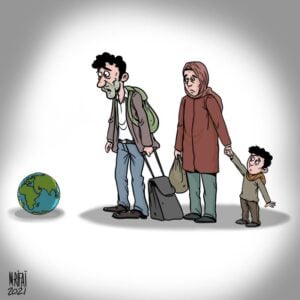
A new report from the International Organization for Migration’s (IOM) Displacement Tracking Matrix (DTM) reveals changing migration patterns among Cubans across Latin America, showing that many are not just transiting through the region but increasingly choosing to stay there. According to IOM, Latin America is evolving from a migration corridor into a destination, with people making deliberate decisions about where they can rebuild their lives in search of better opportunities and stability. This ground‑level data is helping governments develop evidence‑based migration policies that reflect current realities.
The report’s findings, which cover January 2025 to February 2026, are based on field surveys by DTM at key transit and destination points, irregular migration statistics from the governments of Honduras and Guatemala, and official migration figures from Brazil and Uruguay. A recent DTM survey conducted in Costa Rica found that 94 percent of Cuban migrants surveyed during January and February 2026 said they intended to stay in the country, citing better economic prospects, political stability, and improved access to international protection. IOM data also indicates that demand for regularization and asylum procedures in the region is expected to remain high.
At the same time, northbound movements through parts of Central America have dropped sharply. In Honduras, Cuban irregular entries from Nicaragua decreased by about 75 percent, falling from 64,000 in 2024 to 17,000 in 2025, and only 1,500 arrivals were recorded in the first two months of 2026 — less than a quarter of the number from the same period the previous year. In Guatemala, economic reasons were uniformly cited by Cubans surveyed as the primary driver for leaving their homeland.
South America is also emerging as an important destination for Cuban migrants. In Brazil, net regular Cuban migration nearly tripled between 2024 and 2025, rising from around 2,100 to 6,400 people, with no month in 2025 showing a negative balance. Many Cubans enter Brazil through countries such as Venezuela or Guyana, where visas are not required, before travelling into the northern state of Roraima. In Uruguay, the average monthly net migration balance more than doubled from about 500 Cubans in 2024 to over 1,200 in 2025, underscoring Latin America’s growing role as a destination rather than merely a transit region.
The analysis draws on data from more than 20 countries across Latin America and the Caribbean, tracking evolving routes, motivations, and settlement trends. This comprehensive, mixed‑method approach provides a timely, evidence‑based picture of how migration dynamics are changing, informing migration policy design, regional coordination, and humanitarian planning. DTM’s data infrastructure, which operates across the region, plays a key role in supporting these efforts by offering detailed insights to governments and