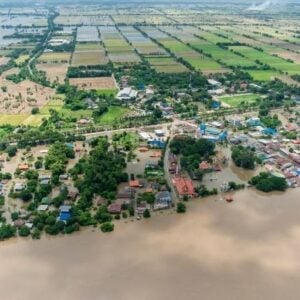
Cyclone Ditwah, which struck Sri Lanka in late November 2025, caused an estimated US$4.1 billion in direct physical damage to buildings, agriculture, and critical infrastructure, equivalent to around 4 percent of the country’s GDP. The cyclone affected nearly 2 million people, including 500,000 families across all 25 districts, disrupting livelihoods, essential services, and the broader economy.
The World Bank Group’s Global Rapid Post-Disaster Damage Estimation (GRADE) report provides timely insights to guide emergency response, recovery planning, and long-term disaster risk reduction. The methodology estimates direct economic damage to physical assets but does not account for income losses, production disruptions, or the full costs of recovery and reconstruction.
The Central province was the hardest hit, with Kandy district alone suffering damages estimated at $689 million due primarily to flooding and landslides. Infrastructure such as roads, bridges, railways, and water networks bore the largest share of damage, totaling $1.735 billion, which disrupted connectivity and access to markets and essential services.
Residential buildings and contents experienced approximately $985 million in damages, highlighting the vulnerability of homes to flooding and high winds. Agriculture, including paddy, vegetables, maize, livestock, and inland fishing, suffered $814 million in damages, threatening food security and rural livelihoods. Non-residential buildings, such as schools, healthcare facilities, businesses, and industrial units, incurred $562 million in damages, interrupting education, healthcare, and economic activities.
The assessment emphasizes that pre-existing socio-economic vulnerabilities—including poverty, limited service access, and exposure to climate risks—amplify the cyclone’s impacts, particularly for women, children, older persons, and female-headed households. Targeted recovery efforts are therefore crucial to support the most at-risk communities.
In response, the World Bank Group has mobilized up to $120 million from ongoing projects to restore essential services and infrastructure, including healthcare, water, education, agriculture, and connectivity in the hardest-hit areas. The report highlights that actual recovery and reconstruction needs are likely to far exceed the direct damage estimates, underlining the importance of comprehensive strategies that integrate climate and disaster risk considerations.
The GRADE assessment was conducted in close collaboration with Sri Lanka’s government, including the External Resources Department, Treasury, National Planning Department, and Disaster Management Centre. Over the past decade, the GRADE approach has supported more than 54 countries, providing rapid, evidence-based post-disaster assessments with approximately 90 percent accuracy compared to detailed ground-based evaluations. The Sri Lanka assessment was financially supported by the Global Facility for Disaster Reduction and Recovery (GFDRR) and Japan’s Ministry of Finance, in collaboration with the World Bank.