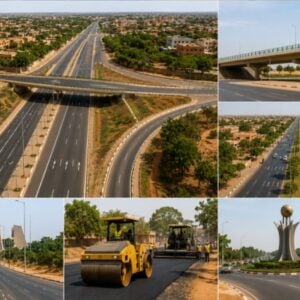
Cotonou — June 1, 2026 — Benin has made significant strides in expanding its road infrastructure, adding 3,000 kilometers of paved roads and 1,400 kilometers of rural tracks over the past decade. This marks a major improvement from 2016, when the country’s paved road coverage stood at just 2,684 kilometers, according to the National Institute of Statistics and Demography (INSTAD).
The expansion has been driven by flagship initiatives under President Patrice Talon, including the “Asphaltage” program, which mobilized nearly $1.2 billion in investment. Road infrastructure has remained a top priority in both phases of the Government Action Program (PAG), with nearly a quarter of the budget allocated to transport. Key corridors such as Djougou‑Péhunco‑Kérou‑Banikoara and Béroubouay‑Kandi‑Malanville have undergone rehabilitation, strengthening internal links and cross‑border trade.
Despite these gains, rural connectivity remains a pressing challenge. A 2023 World Bank report found that fewer than half of rural roads are passable year‑round, with only 23% of rural residents having access to an all‑season road within two kilometers. Benin’s Rural Access Index (RAI) stands at 20%, well below the West African average of 34%, with northern departments facing the sharpest disparities.
Looking ahead, the government plans to shift focus toward east‑west corridors, including the Natitingou‑Guilmaro‑Kérou and Prékété‑Bassila‑Bétérou‑Tchaourou routes, to complement the existing south‑north axis. Secondary roads are also planned to improve local trade and municipal connectivity.
However, sustaining momentum will require overcoming funding constraints and ensuring long‑term maintenance. Rapid urbanization and rising demand for mobility add further pressure, while concerns about construction quality and corridor security remain.
Benin’s progress highlights both the opportunities and challenges of building a modern transport network. Expanding access to rural communities and ensuring durable infrastructure will be critical to unlocking the country’s full economic potential.