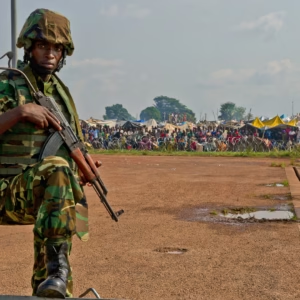
The UN High Commissioner for Human Rights has called for an immediate ceasefire in South Sudan, warning that violence has caused significant civilian casualties in recent weeks. Over the past 17 days alone, more than 160 civilians have reportedly been killed. Among the dead were at least 139 people who were killed on 1 March by fighters from the Bul Nuer ethnic group in the northern Ruweng administrative area, highlighting the severity of the escalating violence.
Further allegations point to serious abuses by government forces. According to the High Commissioner, 21 civilians were killed on 21 February in Pankor village in eastern Jonglei state after soldiers reportedly gathered villagers under the pretense of distributing food aid before opening fire on them. Such actions, he warned, could amount to war crimes. Since December, fighting between government and opposition forces and their allied militias has spread across several states, displacing more than 280,000 people, particularly in Jonglei.
In Ukraine, large-scale missile and drone strikes have recently killed and injured civilians while damaging key infrastructure. UN officials reported that attacks between last Thursday and Monday affected multiple regions, with Kharkiv among the hardest hit. Apartment buildings, a school and other civilian structures were damaged, leaving several people dead or wounded, including children.
Civilian casualties were also reported in Ukraine-controlled areas of the Donetsk region, particularly around Kramatorsk. The strikes damaged ambulances, fire trucks, homes and critical energy and railway infrastructure. UN officials stressed that despite the emergence of new global crises, the war in Ukraine continues to cause significant suffering and must not be overlooked. Humanitarian agencies are providing emergency assistance and have recently delivered supplies to around 1,000 residents in frontline communities in Donetsk.
Meanwhile, the UN World Food Programme has warned that many Palestinians in Gaza continue to face hunger due to limited humanitarian aid entering the territory. Although Israeli authorities reopened the Kerem Shalom crossing following the outbreak of conflict with Iran, aid deliveries remain severely restricted. As a result, humanitarian assistance is reaching people at only minimal levels, leaving the food security situation extremely fragile despite some improvement since the ceasefire began in October.
WFP currently has enough supplies to provide about two weeks of half rations for roughly 1.5 million people in Gaza after previously reducing full rations earlier this year. Aid officials say they hope to increase rations to around 75 percent of normal levels, but current restrictions on food deliveries make this unlikely. Despite the ceasefire agreement between Israel and Hamas, ongoing violence along the line of control continues to threaten both civilians and humanitarian operations.
In Afghanistan, the UN refugee agency has warned that escalating conflicts in the Middle East could trigger further returns of Afghan migrants from neighbouring countries under difficult conditions. Although the border with Iran currently appears calm, tensions are rising and movements may increase soon. Around 110,000 Afghans have already returned from Iran since the beginning of the year, including approximately 1,700 people each day following recent regional tensions.
Over the past two years, more than five million Afghans have returned from neighbouring countries, with nearly 1.9 million returning from Iran in 2025 alone. Many families have experienced repeated displacement, having first fled Afghanistan, then been displaced again within Iran, and now returning once more to uncertain conditions in their home country.
UNICEF has warned that the increasing number of returnees could create serious risks for children. Many families arriving at border crossings such as Islam Qala are exhausted and distressed after difficult journeys, often uncertain about their future. Nearly three million Afghans returned from neighbouring countries in 2025, and around 60 percent of them were families with children.
Children who are separated from their caregivers face particularly high risks of violence and exploitation. During the peak of returns last year, UNICEF assisted more than 8,000 unaccompanied and separated children arriving from Iran and Pakistan. Humanitarian agencies are now preparing to expand support at border crossings and in return areas, providing essential services such as healthcare, vaccinations, nutrition screening, clean water and child protection.