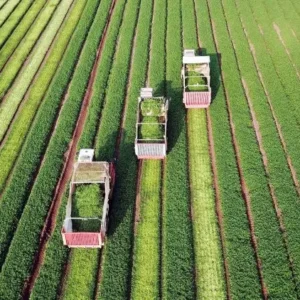
This case study examines how farmer training under India’s Financing Agrochemical Reduction and Management (FARM) project is enabling a large-scale transition toward safer and more sustainable agricultural practices. Led by the United Nations Environment Programme (UNEP) and funded by the Global Environment Facility (GEF), the initiative promotes reduced reliance on harmful chemicals and plastics by strengthening farmers’ capacity to adopt biopesticides and integrated pest management practices. Implemented by the United Nations Industrial Development Organization (UNIDO) in partnership with the state-owned company HIL India Limited, FARM supports sustainable agriculture that protects ecosystems, human health and food security.
India’s biopesticide production capacity has grown significantly in recent years, with 970 registrations covering 18 biopesticide products, compared to 293 conventional pesticides. The biopesticide market is projected to grow at a compound annual growth rate of 11.7 percent between 2022 and 2028. Despite this progress, adoption in agriculture remains limited, particularly among smallholder farmers. Most biopesticides in India are still used in the health sector, such as mosquito control for vector-borne diseases, rather than in crop production.
Several barriers continue to limit uptake in agriculture, including low awareness of biopesticide efficacy and benefits, cost concerns, regulatory challenges and pressure from the conventional chemical pesticide industry. As a result, farmers and local communities remain exposed to serious health risks and environmental degradation, including water contamination. India also continues to use several pesticides that are banned in other parts of the world, reinforcing the urgency of transitioning to safer alternatives.
Raising awareness of biobased products and sustainable farming practices is critical, particularly around the technical aspects of biopesticide handling, application, storage and disposal. While many farmers understand the importance of biocontrol techniques, behaviour change remains challenging without practical, crop-specific guidance. Questions around product sourcing, dosage and suitability for different crops must be addressed to help farmers move away from entrenched chemical-intensive practices developed over decades.
The FARM project in India responds to these challenges by strengthening farmer capacity to adopt biopesticides and by linking training with access to eligible financing schemes. The project aims to phase out persistent organic pollutants and gradually reduce highly hazardous pesticides by enhancing the production of three biopesticides, building farmer knowledge and skills, and supporting the government in strengthening regulatory frameworks for biopesticides.
Training under the project promotes the safe and judicious use of biopesticides across eight crops in 10 Indian states. Farmers receive instruction on core principles such as soil health preservation, risk reduction from conventional pesticides and integrated pest management, alongside hands-on guidance on application methods, recommended dosages at different crop growth stages, safety measures, storage practices and safe disposal of containers. The programme integrates HIL India Limited’s crop solutions, including Bti, Trichoderma and neem-based biopesticides, as practical options for farmers transitioning to safer alternatives.
A key feature of the FARM training model is its specificity and local adaptation. Training materials are tailored to local crops, climatic conditions, topography and available resources in each farming community. The project team analysed farming conditions across 12 climatic zones in India, assessing cropping patterns, pest biology, storage conditions and the feasibility of bioproducts. These insights informed area-specific modules that guide farmers on selecting suitable biocontrol formulations and determining correct dosages based on factors such as crop leaf area index. The project worked closely with agricultural experts from Krishi Vigyan Kendras under the Indian Council of Agricultural Research to ensure technical accuracy and relevance. Training schedules were also designed around crop cycles and farmer availability, with multilingual materials prepared to improve accessibility and understanding.
Access to finance is another critical pillar of the programme. Nearly 80 percent of Indian farmers are smallholders cultivating one to two acres of land, making them highly sensitive to yield and income risks during transitions to new practices. FARM training highlights available financing mechanisms, incentives and insurance schemes that help protect farmer incomes while adopting biopesticides. One such example is the Government of India’s Paramparagat Krishi Vikas Yojana, which promotes organic farming through support for biocontrol, compost and manure use. Under the scheme, farmers receive financial assistance of approximately USD 360 per hectare over three years, helping ease the transition while opening access to higher-value organic and export markets.
The programme also recognises farmers as skilled practitioners rather than passive recipients of knowledge. Training builds on farmers’ experience, cultural traditions and local networks, addressing hesitation through trusted information and visible results. A peer-sharing model plays a central role, with local farmers who have successfully adopted biocontrol practices sharing experiences alongside scientists, experts and community leaders. This approach builds credibility and confidence by demonstrating real-world improvements in crop health, yields and profitability.
Between July 2024 and July 2025, more than 20,000 farmers were directly trained under the project, with around 1.7 million farmers benefiting indirectly. Through a training-of-trainers model implemented by HIL India Limited, each trained participant is expected to reach an additional 80 to 100 farmers in their own and neighbouring villages. While still in its early phase, the project builds on a proven model implemented between 2016 and 2022 that reached over 70,000 farmers and contributed to reduced pesticide residues in food crops. National-level impacts include increased biopesticide consumption and higher exports of organic produce, generating additional income for farmers.
Positive outcomes are already emerging at the community level. In Ukrem village in Meghalaya, a group of women farmers established a small biocontrol production unit in 2023 after combining training insights with government financial support introduced during the sessions. The unit now supplies products to nearby villages and generates up to USD 600 in additional monthly income for the women involved.
Despite these successes, challenges remain. Long-standing reliance on chemical pesticides means some farmers are resistant to change, highlighting the need for sustained training and behaviour change advocacy. Biocontrol solutions must also demonstrate faster and more consistent results to compete with quick-acting synthetic pesticides, requiring continued research and product development. In addition, biopesticides are not yet mainstreamed in retail markets, where dealers often serve as the first point of contact for farmers. Greater engagement with distributors will be essential to scale adoption.
Looking ahead, the FARM project aims to deepen farmer confidence through field demonstrations and continued knowledge-sharing while expanding the commercial viability of HIL’s biopesticide products. The project also plans to further develop its three biosolutions ahead of commercialization by the end of 2026, reinforcing its goal of empowering up to one million farmers to transition toward safer, more resilient and sustainable agriculture in India.