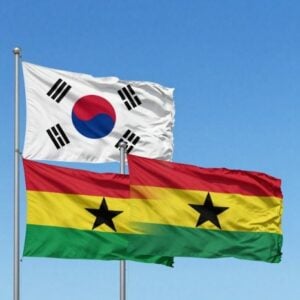
Ghana and South Korea are deepening their development partnership, focusing on infrastructure, health systems, and local economic growth. The renewed engagement followed high-level discussions between officials from the Korea International Cooperation Agency (KOICA) and Ghana’s National Development Planning Commission (NDPC), during which both sides assessed ongoing projects and explored opportunities to expand collaboration in sectors with strong economic multiplier effects.
NDPC Chairman Nii Moi Thompson emphasized the value of learning from South Korea’s development experience, highlighting the importance of strong institutions, applied research, and efficient systems over simply increasing spending. He noted that Ghana’s development challenges increasingly require structural and institutional solutions to ensure that investments yield measurable results.
Rail transport research and development was identified as a key area for potential collaboration. Thompson cited South Korea’s Railway Research Institute as a model Ghana could adapt to support industrialization, reduce logistics costs, and enhance regional connectivity. He stressed that research-driven infrastructure planning could help ensure transport investments directly benefit local industries and economic clusters. On the health front, he expressed concern about rising maternal mortality in Ghana despite increased public expenditure, attributing the issue to systemic inefficiencies. He called for re-engineering institutional processes within the health delivery system, particularly the Community-based Health Planning and Services (CHPS) programme, to improve outcomes before committing additional resources.
Dr. Thompson underscored that improving coordination, accountability, and workflow efficiency is critical to ensure public spending delivers better health outcomes and value for money.
Representing KOICA, Ms. Boyeon Choe reaffirmed South Korea’s commitment to supporting Ghana’s development agenda, especially projects with tangible community-level impact. She highlighted KOICA’s willingness to expand or scale up successful interventions and noted plans to launch the Local Economic Development Project, which will strengthen agribusiness value chains to promote job creation, value addition, and inclusive growth.
The discussions concluded with a shared commitment to development partnerships that prioritize efficiency, sustainability, and measurable economic impact, reflecting a shift toward cooperation driven by institutional strength and long-term outcomes rather than short-term inputs.