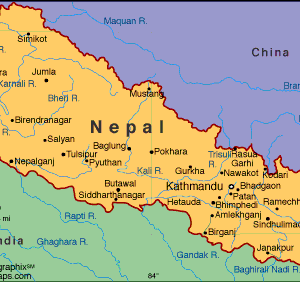
The World Bank’s Board of Executive Directors has approved a $52 million credit to support the Nepal Clean Air and Prosperity Project, which aims to reduce air pollution and strengthen air quality management across the country. The initiative will focus on lowering emissions of fine particulate matter (PM2.5), particularly from industrial and commercial boilers and furnaces. The project will prioritize highly affected regions including the Kathmandu Valley, the Terai, and surrounding foothill areas where air pollution poses serious health and environmental risks.
Air pollution has become a major public health and economic challenge in Nepal, costing the country more than six percent of its gross domestic product each year due to healthcare expenses and reduced labor productivity. As Nepal continues to industrialize, emissions from industries are expected to become the largest source of air pollution, highlighting the urgent need for cleaner production technologies and improved environmental management systems.
To address these challenges, the project will support approximately 400 industrial and commercial enterprises in adopting cleaner and more efficient technologies. These include electric boilers and furnaces, modern biomass-based systems, and advanced emission control technologies. By combining financing for clean technologies with incentives and technical support, the initiative aims to help businesses transition toward more sustainable operations while reducing operational costs and improving competitiveness.
The project also seeks to overcome key barriers to adopting clean technologies in Nepal, such as high upfront investment costs, limited access to long-term financing, and low technical capacity among enterprises. By providing long-term financing options, targeted capital incentives, and hands-on technical assistance, the initiative will help industries implement cleaner production methods and significantly reduce pollution levels.
Implementation of the project will be led by the Department of Industry under the Ministry of Industry, Commerce and Supplies and the Department of Environment under the Ministry of Forests and Environment. Rastriya Banijya Bank will manage the clean technology financing facility. In addition to the World Bank’s credit, the project is supported by a $5 million grant from the Resilient Asia Program funded by the United Kingdom’s Foreign, Commonwealth and Development Office and the Swiss Agency for Development and Cooperation. The initiative also forms part of the World Bank’s broader Regional Air Quality Management Program targeting pollution in the Indo-Gangetic Plains and Himalayan Foothills, one of the world’s most severe air pollution hotspots.