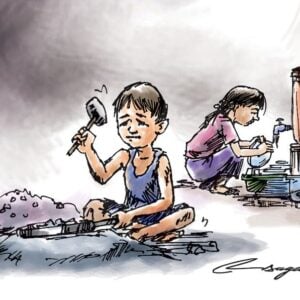
Nepal continues to face a serious challenge in eliminating child labour, with national estimates indicating that 1.1 million children are engaged in work, including 220,000 in hazardous occupations. Despite progress, child labour persists in sectors such as brick kilns, woollen carpets, and entertainment, highlighting the need for stronger, coordinated action across all levels of government.
To address this, ILO Nepal is enhancing collaboration with national and provincial partners to reinforce child labour elimination and child protection systems. ILO Country Director Numan Özcan visited Hetauda and Chitwan in Bagmati Province to participate in a provincial dialogue, emphasizing the need for integrated, multi-dimensional responses and highlighting global and national trends on child labour.
The Ministry of Labour, Employment and Social Security (MoLESS) is implementing the second National Master Plan (NMP-II) to eliminate child labour, with technical support from the ILO-PPLL Project. A central strategy under NMP-II is the Child Labour Free Zone (CLFZ) approach, which empowers local governments to lead elimination efforts. To date, 12 municipalities and rural municipalities have completed CLFZ declarations, conducting baseline surveys, stakeholder orientation, and establishing monitoring systems.
Recognizing the importance of sustainable monitoring and coordination, the ILO-PPLL Project has partnered with the National Child Rights Council (NCRC) to strengthen provincial and local capacities in preventing, detecting, and responding to child labour. Key activities included a provincial dialogue in Hetauda and a two-day training programme for frontline actors in Sauraha, Chitwan, focusing on child labour measurement, detection, monitoring, and CLFZ implementation.
At the provincial dialogue, Numan Özcan highlighted the role of provinces in connecting federal and local governments and aligning education, social services, and labour administration. He emphasized that coordinated, multi-dimensional strategies are essential to ensure CLFZ efforts become part of a functioning system rather than isolated events, advancing Nepal’s progress toward SDG Target 8.7.
The CLFZ approach remains a promising strategy, with over 200 local governments engaged in recent years. Strengthened coordination among MoLESS, NCRC, and provincial authorities is critical to accelerate implementation across all 753 local governments. Numan Özcan also commended MoLESS for timely reporting to the ILO’s Committee of Experts on Conventions No. 182 and No. 138, both ratified by Nepal.
Looking ahead, the ILO is working with the National Statistics Office to prepare the next Labour Force Survey, which will provide updated national and provincial data on child labour, including hazardous work. This information will guide future priorities and help Nepal maintain momentum as a Pathfinder Country for SDG 8.7.
The ILO remains committed to supporting the Government of Nepal, workers’ and employers’ organizations, and civil society partners in eliminating child labour and strengthening child protection systems nationwide.