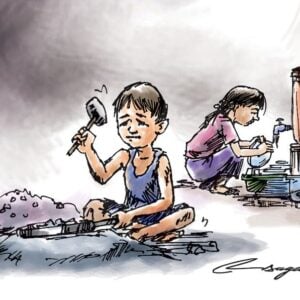
Global unemployment may be holding steady, but meaningful progress toward decent work has slowed to a standstill, according to the International Labour Organization’s Employment and Social Trends 2026 report. While economic growth has shown resilience, the report warns that millions of workers—particularly young people and women—continue to face poor job quality, insecurity, and exclusion, with emerging risks from artificial intelligence and global trade uncertainty adding further pressure.
The ILO projects that the global unemployment rate will remain at 4.9 per cent in 2026, representing around 186 million people. However, stable figures mask deeper structural problems, as vast numbers of workers remain unable to access decent and secure employment. ILO Director-General Gilbert F. Houngbo cautioned that headline stability should not overshadow the reality that hundreds of millions of people are still trapped in poverty, informality, and vulnerable forms of work.
Job quality remains under severe strain across much of the world. Nearly 300 million workers continue to live in extreme poverty, earning less than US$3 a day, while informality is on the rise. By 2026, an estimated 2.1 billion workers are expected to be in informal employment, often without social protection, labour rights, or job security. Progress has been particularly weak in low-income countries, where already vulnerable workers are falling even further behind. The report highlights the slow pace of economic transformation toward higher-value industries and services as a key barrier to improving productivity and job quality.
Young people face some of the most acute challenges. Youth unemployment rose to 12.4 per cent in 2025, and around 260 million young people are not in education, employment, or training. In low-income countries, more than one in four young people fall into this category. The ILO also warns that artificial intelligence and automation could intensify these difficulties, especially for educated youth in high-income countries seeking entry into skilled occupations. While the full impact of AI remains uncertain, the report stresses the need for close monitoring and proactive policy responses.
Gender inequalities in the labour market remain deeply entrenched. Women account for only two-fifths of global employment and are 24 per cent less likely than men to participate in the labour force. Progress in female labour force participation has stalled, largely due to persistent social norms and structural barriers, slowing advances toward gender equality at work.
Demographic shifts are further reshaping labour markets worldwide. Ageing populations in higher-income countries are constraining labour force growth, while low-income countries are struggling to convert rapid population growth into productive employment. Employment growth in 2026 is projected to reach just 0.5 per cent in upper middle-income countries, compared with 1.8 per cent in lower middle-income economies and 3.1 per cent in low-income countries. Without sufficient job creation, poorer nations risk missing out on the potential benefits of their demographic dividend. Weak productivity growth in these economies is also widening geographic inequalities and delaying convergence with advanced economies.
At the same time, global trade disruptions are adding uncertainty to labour markets. Unclear trade rules and supply chain bottlenecks are weighing on wages, particularly in Southeast Asia, Southern Asia, and Europe. Despite these challenges, trade continues to support around 465 million jobs worldwide, with more than half located in Asia and the Pacific. The report notes that trade can be a powerful driver of decent work, especially in low- and middle-income countries, where export-linked sectors often offer better pay, lower informality, and more opportunities for women and youth. Digitally delivered services now make up 14.5 per cent of global exports, and nearly half of all trade-related jobs are in market services, although many African and South American countries remain heavily dependent on extra-regional markets.
Houngbo emphasized the urgency of coordinated action to prevent decent work deficits from becoming entrenched. He called on governments, employers, and workers to work together to boost productivity through investment in skills, education, and infrastructure; address gender and youth gaps; strengthen the link between trade and decent work; and manage risks arising from debt, artificial intelligence, and trade uncertainty. Without coherent and inclusive policy responses, he warned, social cohesion and progress toward social justice will remain under threat.